Tuesday, November 16, 2010

HEY HEY, MY MY. NEIL YOUNG'S LINCVOLT IS A CRISPY FRY.


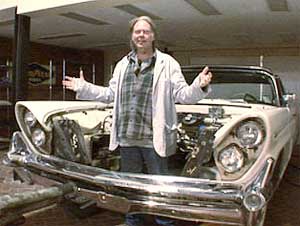
Rocker Neil Young's LincVolt in happier times.

By Cammie

Linc-Volt, Neil Young's electric hybrid 1959 Lincoln, has caused an extensive fire at Young's archival warehouse, according to news reports.


LincVolt rose to fame as an off-beat early entrant in the Progressive Automotive X Prize competition. Although it failed to win, many vintage car and green enthusiasts were stoked by the effort at blending 1950s style and size with futuristic hybrid electric power.

The famous car and much of Young's rock & roll memorabilia was damaged in the fire. I suspect this is one time when it's not "better to burn out than to be forgotten."

Hey Neil, don't let it bring you down . . . the damage is done.

I suspect a lot of hybrid car skeptics will "hope Neil Young will remember" a roddin' man don't need hybrid cars around any how." But some of us hope that LincVolt powers up again to be shockin' the Free World another day.

But for all those Willie Wiredhands who believe that Reddy Kilowatts are the future of motoring, this is a smokey lesson: "Hey, let's be careful out there!"

Labels: , , , ,

Tuesday, December 08, 2009

BBC TOP GEAR LAUDS FOCUS RS & FIESTA ECONETIC

[Get the latest "Truth With Speedzzter" here]

We'll probably see it on BBC America in about 2011, but according to Ford Motor Company's "official blog", the internationally-respected "Top Gear" has awarded both Ford Focus RS and Ford Fiesta ECOnetic "Car of the Year" Awards.

The Ford Focus RS, the fastest and the most powerful front-wheel-drive Ford ever produced in Europe, has been selected as "Muscle Car of the Year" by BBC Top Gear magazine, while Ford's lowest carbon emitting model, the 98g CO2/km Ford Fiesta ECOnetic is Top Gear's "Green Car of the Year".


The "Top Gear" awards dovetail well with last month's announcement of Ford Fusion as Motor Trend Magazine's 2010 Car of the Year.

Of course neither the Focus RS nor the Fiesta ECOnetic are available in the United States of America.

One of the principal criticisms of Ford overhead during the 2010 SEMA Show was that Ford had neglected the sport compact market niche by depriving Americans the Focus RS.

The beancounters and marketers among Ford's Glass House Gang apparently believe there's no "business case" for offering the RS in America. Indeed the market for a $30,000+ FWD hot rod may be limited. And for most Americans, considering the RS as a proper "muscle car" would be a bit of a stretch (notwithstanding its awesome objective performance numbers)

But ever since the somewhat underpowered Focus ST170 (known in America as the SVT Focus) was discontinued after the 2004 model year, Ford has offered little more than sporty appearance packages for American customers desiring high performance in something that's smaller and more fuel efficient than a Mustang.

While turbocharging the SVT Focus would have easily answered Chevrolet's Cobalt SS and Dodge's SRT-4 in the marketplace (and likely have conquested a few sales from Honda, Toyota, Nissan and Mitsubishi), Ford didn't make any move to compete in the U.S. It was another missed opportunity to be sure.

Now, the impending 35 m.p.g. CAFE standards leaves Ford little choice but to shift some high performance demand into smaller cars.

Truth With Speedzzter is no fan of front wheel drive and would prefer the high m.p.g. end of Ford's performance line-up to be anchored by a "right-sized" RWD or AWD, powered by a electric hybridized, turbocharged (or "VW/Lancia-style twincharged"), Ethanol Boosting Systems' direct-injected DOHC V-8 (not a V-6 or I-4) of about 2 to 2.5 liters displacement.

With cylinder deactivation, variable valve timing and phasing, and variable geometry intake manifolding, a boosted 2-2.5 liter V8 could run most of the time on a combination of electricity and four cylinders, but still pack a 150+ horsepower-per-liter ethanol-boosted "sledgehammer" punch when necessary. In a lighter RWD or AWD platform (target power-to-weight of ~ 8 pounds per horsepower), such a vehicle would combined startling fuel economy with spectacular performance. And it could produce most all of the traditional V8 sounds that American enthusiasts love on demand.

But short of a such a modern, high-performance "V8-60" for the 21st Century, the Focus RS . . . or a cheaper EcoBoost Focus for America would be a small step in the right direction.

Congratulations to Ford for these "Cars of the Year!"

Labels: , , , , , , , , , ,

Tuesday, December 01, 2009

2009 L.A. AUTO SHOW--DOES CAPSTONE'S TURBINE HYBRID PREDICT A TURBINE CAR RESURGENCE?

[Get the latest "Truth With Speedzzter" here]

CNET is reporting that "Capstone, manufacturer of electricity-generating microturbines, and Electronic Arts Chief Creative Director Richard Hilleman have built a hybrid sports car for the upcoming Los Angeles Auto Show."

The Capstone's "Reddy Kilowatt" turbine dream car is based on Factory Five's GTM supercar.

CNET reports taht "The CMT-380 uses an electric power train with a range-extending diesel-fueled microturbine. A lithium polymer battery pack gives the CMT-380 80 miles of pure electric range, and the microturbine generates power for an additional 500 miles."

Capstone usually produces stationary microturbines for power generation.

This demonstration project has already prompted spirited debate on the future of turbines as the generating component of future electric hybrids -- which seems to be the whole point of the CMT-380 exercise.

Ever since the days of Andy Granatelli's Studebaker STP Special turbine cars at Indianapolis, John Zink's Boeing-powered Trackburner and Chrysler's flirtations with turbine engines, many advanced engineering enthusiasts have dreamed of futuristic turbine-powered automobiles.

Cost and part-throttle efficiency have doomed highway-bound turbine projects. Cost, insufficient development, and rulesmakers stopped turbines at the track.

Some speculate that using microturbines to power electric generators could overcome the limitations of turbine power.

While this may someday prove true, Truth With Speedzzter expects electrification to be primarily based on torquey internal combustion reciprocating engines instead of turbines. ICE engines can be more effectively used to "backstop" and "supplement" electric power in peak demand situations. Turbine hybrid designs would require complex transmission systems to obtain the same performance. Thus, turbine hybrids would be completely reliant upon electricity to drive the wheels.

Moreover, pure turbine technology has not yet shown cost competitiveness with proven ICE engines. Most certainly as turbocharger technology continues to develop, adding a combuster and energy recovery systems will likely be achieved at a reasonable price point. In fact, integration of these components into a piggy-backed "turbogenerator" (also fed by ICE waste heat) might be a better solution to the electrification and power density problems.

Still the CMT-380 is an interesting application of turbine/electric power, even if it's not very "real world" at the moment.

Labels: , , , ,

WHAT IS THE BIG CUBIC-INCH TURBO BLOG? It is a real-time on-line book about the theory and practice of turbocharging B-I-G CUBE V8 Engines.

what is this?

Tell me when this blog is updated. . .

  • Copyright 2004, 2005, 2006, 2007, 2008, 2009, 2010, 2011, 2017. All Rights Reserved. The BIG-CUBIC INCH TURBO BLOG may be quoted with attribution and/or linking to the original post at "THE BIG CUBIC-INCH TURBO BLOG", subject to the Fair Use provisions and limitations of U.S. Copyright law. The trademarks and service marks appearing herein are the property of their respective owners and "Truth With Hydra and Cammie: The Lifter Sisterz" and its predecessor are not affiliated in any way with the holders of these trademarks and service marks. Such trademarks and servicemarks appear herein under the Fair Use provisions of U.S. copyright law. Truth With Hydra and Cammie claims no copyright interest in photos, videos, and articles linked here from internet sources. All materials linked here are for a non-commecial purpose and appear herein under the Fair Use provisions of U.S. copyright law.